We continue from the foundations of psychoanalysis into later twentieth-century developments. After Freud, Jung, and Adler, clinicians kept the idea that unconscious processes matter, while they asked new questions: how the ego organizes everyday life, how early relationships are carried inside the person, how a sense of self is built through others, and how psychoanalytic work can be focused in a shorter treatment.
Ego Psychology
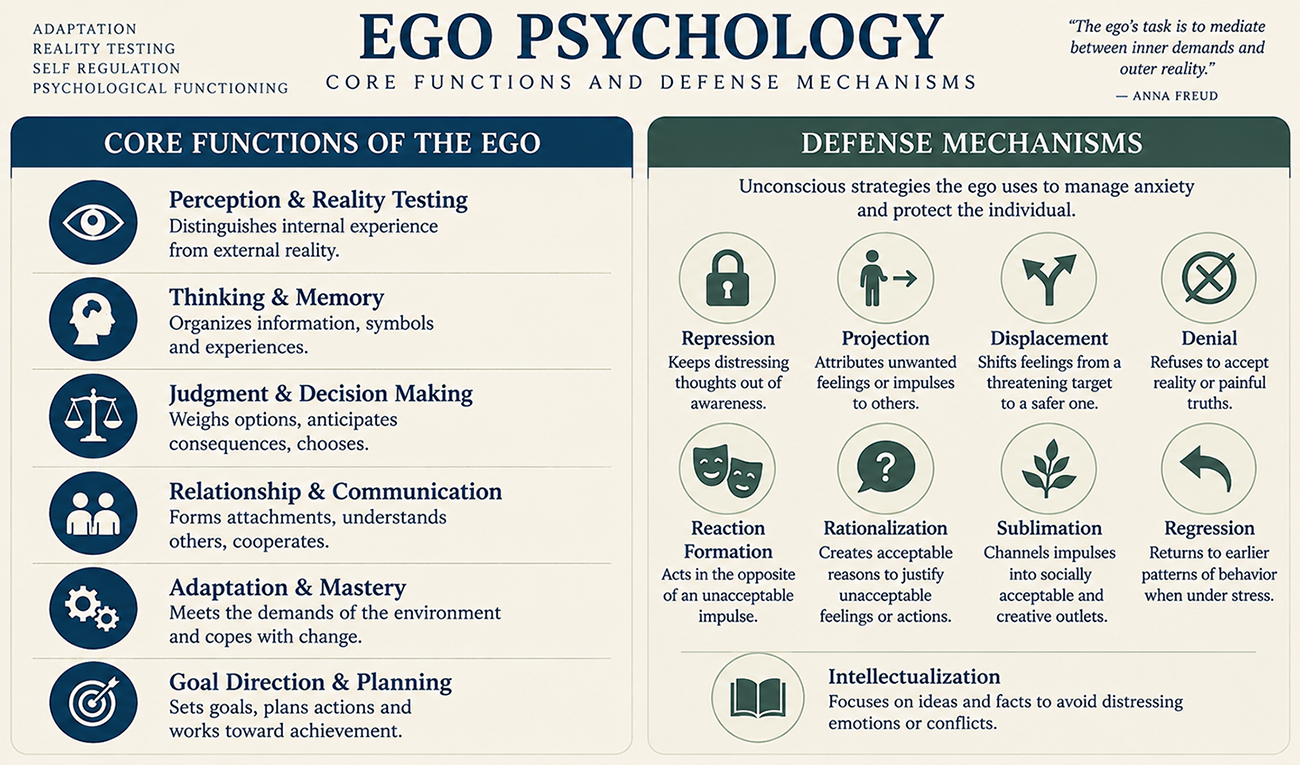
Ego Psychology developed from Freud's later structural model of the mind and became one of the major developments within twentieth-century psychoanalysis. While Freud had described the ego as one of three major structures of the psyche, later psychoanalysts began to examine its functions in greater detail (Blanck & Blanck, 1994, pp. 22-23). They became increasingly interested in how the ego allows a person to perceive reality, regulate impulses, form relationships, solve problems, and adapt to the demands of the external world (Goldstein, 2008).
This represented a shift in emphasis within psychoanalytic theory. The unconscious conflicts described by Freud remained important, but the ego was no longer viewed primarily as the part of the mind caught between the demands of the id, superego, and external reality. Ego psychologists argued that the ego also possesses functions that allow the individual to organize experience and respond to the environment.
Freud's structural model provided the starting point. The id represented instinctual drives, the superego represented internalized demands and prohibitions, while the ego dealt with both internal pressures and the external world. Ego Psychology expanded this understanding by asking what the ego actually does in everyday psychological functioning.
Anna Freud played an important role in this development through her work on defense mechanisms. In The Ego and the Mechanisms of Defense (1936/1937), she examined the ways in which the ego responds to anxiety and manages thoughts, feelings, and impulses that may be difficult to tolerate. Her work helped shift attention toward the ego's role in regulating psychological experience.
Heinz Hartmann later developed Ego Psychology further (Blanck & Blanck, 1994, pp. 26-39). In Ego Psychology and the Problem of Adaptation (1939), he argued that some ego functions could operate independently of unconscious conflict. Functions such as perception, learning, thinking, and motor coordination could therefore be studied as capacities that help the individual adapt to reality.
Key Concepts
- Ego Functions: Psychological capacities such as perception, memory, thinking, planning, and reality testing that help a person organize their experience and respond to the environment.
- Defense Mechanisms: Processes through which the ego manages anxiety and protects the individual from psychological distress.
- Reality Testing: The ability to distinguish internal thoughts, wishes, and perceptions from events occurring in the external world.
- Adaptation: The capacity to respond effectively to changing demands and conditions in the environment.
- Conflict-Free Functions: Hartmann proposed that some ego functions could operate relatively independently of unconscious conflict.
- Ego Development: Ego psychologists became increasingly interested in how these capacities develop throughout childhood and contribute to psychological functioning.
Ego Psychology as a Therapeutic Approach
The development of Ego Psychology also influenced psychoanalytic treatment. Rather than focusing exclusively on uncovering unconscious conflicts, therapists could examine how difficulties in ego functioning affected a person's ability to regulate emotions, maintain relationships, distinguish reality from internal experience, and respond to everyday demands (Kris, 1951). The therapist therefore considered both what was causing psychological conflict and how the individual was managing that conflict. A person's defenses, coping abilities, reality testing, and capacity for adaptation could all become part of the clinical formulation.
This broadened the scope of psychoanalytic therapy. Psychoanalysis could be concerned not only with uncovering what had been repressed, but also with understanding the psychological capacities that allow a person to function in the world. This development would influence later psychodynamic approaches and provide part of the foundation for the next major shift in psychoanalytic theory.
Object Relations Therapy
Object Relations Theory developed from psychoanalysis in the 1930s and 1940s (Scharff & Scharff, 1998, pp. 41-64), shifting attention toward the relationships through which personality develops. Instead of viewing psychological life mainly in terms of drives and conflict within the individual, object relations theorists examined how early relationships become represented internally and influence later expectations, emotions, and patterns of relating. The term object refers to a person or significant other toward whom emotional experience is directed, usually beginning with the infant's relationship with caregivers. These relationships are gradually represented within the developing psyche. Later relationships can therefore be shaped by expectations formed through earlier experiences.
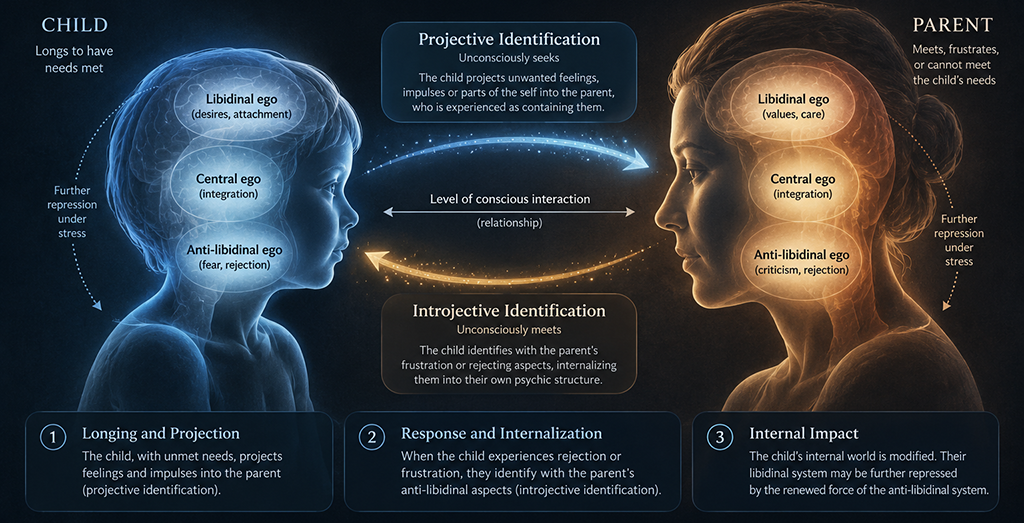
Melanie Klein placed early relationships at the center of psychoanalytic theory. She proposed that infants experience caregivers through powerful emotional states and develop internal representations of both the self and the other. Her concepts of internal objects, splitting, projection, and the paranoid-schizoid and depressive positions became central to object relations theory (Klein, 1946, 2018).
W. R. D. Fairbairn moved further from Freud's drive theory, arguing that people are fundamentally oriented toward relationships. For Fairbairn, psychological difficulties often arise when early relationships are experienced as frustrating, rejecting, or unavailable, leading aspects of those relationships to become internalized (Fairbairn, 1944).
Donald Winnicott placed particular emphasis on the caregiving environment. His concepts of the good-enough mother, holding environment, transitional objects, and true and false self described how adequate early care supports the development of a stable and spontaneous sense of self (Winnicott, 1953, 1960/1986).
Key Concepts
- Internal Objects: Mental representations of significant relationships that influence how later relationships are experienced.
- Splitting: Separating contradictory experiences of the self or another person into distinct representations, such as entirely good or entirely bad.
- Projection: Attributing unwanted feelings or impulses to another person.
- Internalization: Incorporating aspects of relationships and caregiving experiences into psychological functioning.
- Transitional Object: An object, such as a blanket or toy, that helps the child manage the transition from dependence on the caregiver toward greater psychological independence (Winnicott, 1953).
- Holding Environment: The physical and emotional conditions provided by a sufficiently responsive caregiver that allow the infant to develop safely.
- True and False Self: Winnicott's distinction between spontaneous, authentic experience and a defensive adaptation to environmental demands.
Object Relations Therapy examines how earlier relationships may be represented and repeated in present relationships, including the therapeutic relationship itself. The therapist pays attention to patterns of attachment, expectations of others, emotional reactions, and the ways the patient experiences both self and other (Scharff, 1996). The therapeutic relationship provides an opportunity to observe these patterns as they occur in the present.
Self-Psychology (Kohutian)
Self-Psychology developed primarily through the work of Heinz Kohut in the 1960s and 1970s. Kohut initially worked within psychoanalysis but became increasingly critical of explanations that understood psychological difficulties mainly through conflict between drives, prohibitions, and internalized objects. Instead, Kohut placed the self at the center of psychological development. He examined how a person's sense of cohesion, worth, continuity, and agency develops through relationships with important others (Baker & Baker, 1987). For Kohut, early caregivers are important not simply because they become internal representations, but because they perform psychological functions necessary for the development and maintenance of the self. He described these relationships as involving selfobject experiences.
Kohut proposed that infants initially depend heavily on caregivers for psychological functions that they cannot yet provide independently. Through sufficiently responsive relationships, these functions can gradually become internalized.
Two early needs were particularly important:
- Mirroring: the child needs recognition, affirmation, and an appropriate response to their emerging sense of importance and achievement (narcissistic needs).
- Idealization: the child needs to experience an important other as strong, calm, and dependable and to feel connected to that strength.
Kohut later described a third dimension:
- Twinship or alter-ego experience: the need to experience a sense of similarity and belonging with others.
These experiences contribute to the development of a cohesive and stable self (Magid et al., 2021).
A central concept in Self Psychology is the selfobject. A selfobject is not simply another person. It refers to a relationship or experience in which another person performs a psychological function that supports the individual's sense of self. A child may therefore experience a caregiver as providing admiration, security, calmness, or a sense of belonging. These functions initially depend heavily on the relationship and become increasingly available within the developing self through transmuting internalization. This process does not mean that the person simply copies the caregiver internally. Rather, repeated selfobject experiences contribute to the gradual development of psychological capacities that can eventually be maintained with greater independence.
Empathy became particularly important in Kohut's clinical approach. Kohut viewed empathy as a primary method for understanding the patient's subjective experience. The therapist attempts to understand psychological experience from the patient's perspective before interpreting it. This represented an important change from more classical approaches that emphasized uncovering unconscious conflict and interpreting resistance and transference.
Kohut also reconceptualized narcissism. Rather than treating narcissism primarily as an expression of pathological self-love, he considered narcissistic development to be a normal part of psychological development. Problems arise when important developmental needs are repeatedly frustrated, interfering with the development of a cohesive self. This became particularly important in Kohut's understanding of narcissistic personality pathology.
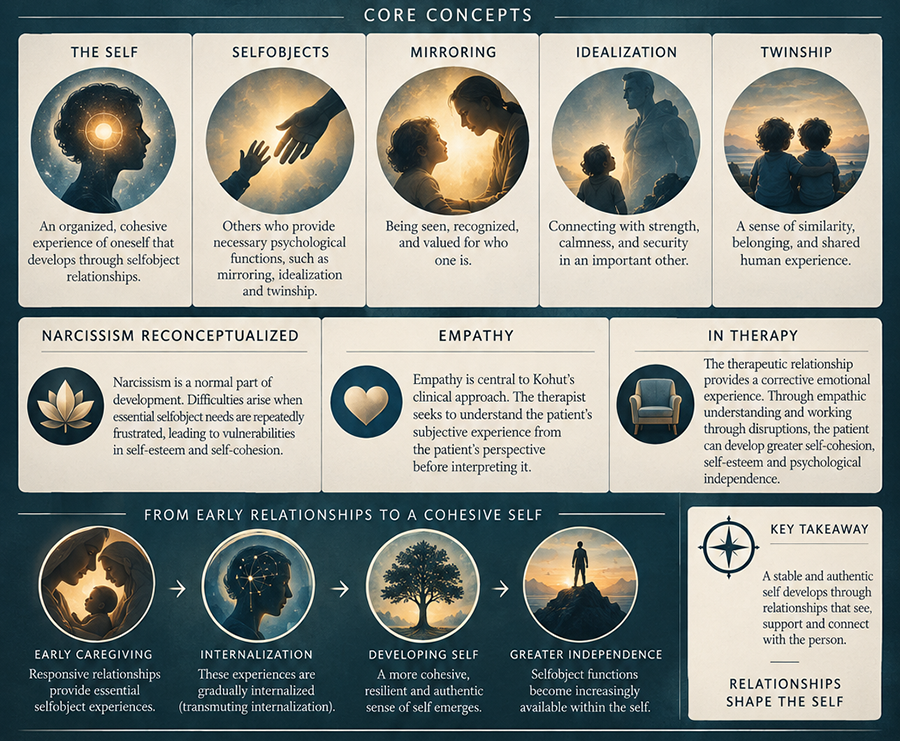
Self-Psychology focuses on the patient's subjective experience and the ways relationships support or threaten the cohesion of the self. The therapist pays particular attention to selfobject needs, empathic failures, narcissistic vulnerabilities, and disruptions in self-esteem and self-cohesion (Baker & Baker, 1987). The therapeutic relationship itself becomes an important setting in which these patterns emerge. Rather than viewing every therapeutic reaction primarily as a disguised repetition of earlier conflict, the therapist considers what psychological function the relationship is serving for the patient. Through empathic understanding and the working-through of disruptions in the therapeutic relationship, the patient may develop greater self-cohesion, affect regulation, self-esteem, and psychological independence.
Brief Psychodynamic Theory
Brief Psychodynamic Therapy developed during the second half of the twentieth century as clinicians began adapting psychoanalytic principles to shorter and more focused forms of treatment (Caselli et al., 2023). Rather than attempting the broad exploration associated with classical psychoanalysis, these approaches sought to identify a central psychological conflict or recurring relational pattern and work with it within a defined period of treatment. Major developments included the focal psychotherapy of Michael Balint and David Malan, the short-term approaches of Peter Sifneos and Habib Davanloo, and later interpersonal and supportive-expressive models developed by Lester Luborsky and by Hans Strupp and Jeffrey Binder.
Classical psychoanalysis was designed around sustained exploration of unconscious conflict, with treatment potentially continuing for several years. Brief psychodynamic approaches retained the importance of unconscious processes, early experiences, transference, and psychological conflict, but introduced a more selective approach to treatment. Michael Balint and his colleagues developed focal psychotherapy, emphasizing the identification of a central problem around which treatment could be organized. David Malan later developed this approach further, using formulations of underlying conflict to help therapists maintain a clear therapeutic focus. Peter Sifneos and Habib Davanloo developed more active forms of short-term psychodynamic treatment, while Lester Luborsky developed supportive-expressive psychotherapy, in which recurring relationship patterns became a central focus of treatment. Strupp and Binder subsequently developed Time-Limited Dynamic Psychotherapy, placing greater emphasis on recurring interpersonal patterns and the patient's interactions with others (Winston & Winston, 2002).
Key Concepts
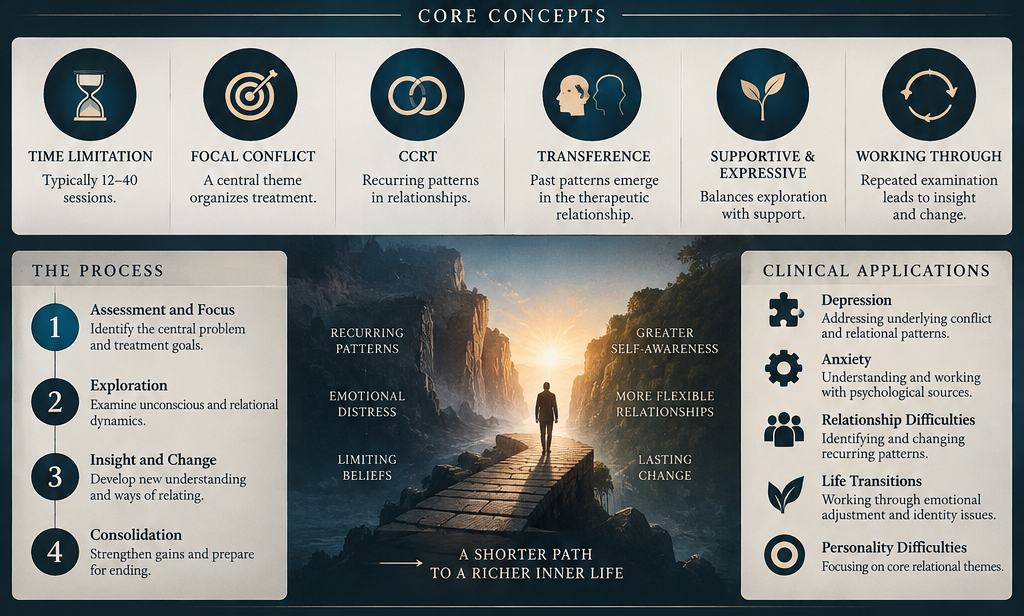
- Time-Limited Treatment: Therapy is conducted within a defined number of sessions rather than remaining open-ended.
- Focal Conflict: Treatment identifies a central psychological conflict or problem that organizes the work.
- Core Conflictual Relationship Theme: Luborsky's CCRT examines recurring patterns involving what a person wants from others, how they experience others responding, and how they respond in turn.
- Transference: Patterns of expectation and response can emerge within the therapeutic relationship and provide material for understanding recurring interpersonal difficulties.
- Supportive and Expressive Techniques: The therapist may combine interpretation and exploration with support, clarification, and attention to the patient's ability to manage emotional experience.
- Working Through: Repeated examination of a central conflict or relational pattern allows the patient to recognize and reconsider patterns that have previously remained outside awareness.
Brief Psychodynamic Therapy as a Therapeutic Approach
Brief Psychodynamic Therapy focuses on identifying a limited area of psychological difficulty and examining the unconscious and interpersonal processes that maintain it. Early sessions are used to establish a treatment focus and develop an understanding of recurring patterns. Relationship episodes can provide material for identifying the patient's wishes, expectations of others, and characteristic responses to interpersonal situations. The therapist therefore works within a defined framework while maintaining attention to transference and the therapeutic relationship. The aim is not to reconstruct every aspect of the patient's developmental history, but to use a focused exploration of psychological conflict and recurring relationships to promote greater insight and more flexible functioning.
References
- Baker, H. S., & Baker, M. N. (1987). Heinz Kohut's self psychology: An overview. The American Journal of Psychiatry, 144(1), 1-9. https://doi.org/10.1176/ajp.144.1.1
- Blanck, G., & Blanck, R. (1994). Ego psychology: Theory and practice. Columbia University Press.
- Caselli, I., Ielmini, M., Bellini, A., Zizolfi, D., & Callegari, C. (2023). Efficacy of short-term psychodynamic psychotherapy (STPP) in depressive disorders: A systematic review and meta-analysis. Journal of Affective Disorders, 325, 169-176. https://doi.org/10.1016/j.jad.2022.12.161
- Fairbairn, W. R. D. (1944). Endopsychic structure considered in terms of object-relationships. The International Journal of Psycho-Analysis, 25, 70.
- Freud, A. (1937). The ego and the mechanisms of defense (C. Baines, Trans.). Hogarth Press. (Original work published 1936)
- Goldstein, E. G. (2008). Ego psychology theory. In K. M. Sowers, C. N. Dulmus, & B. A. Thyer (Eds.), Comprehensive handbook of social work and social welfare: Human behavior in the social environment (Vol. 2). John Wiley & Sons. https://doi.org/10.1002/9780470373705.chsw002008
- Klein, M. (1946). Notes on some schizoid mechanisms. Developments in Psychoanalysis, 1, 292-320.
- Klein, M. (2018). Some theoretical conclusions regarding the emotional life of the infant. In Developments in psychoanalysis (pp. 198-236). Routledge.
- Kris, E. (1951). Ego psychology and interpretation in psychoanalytic therapy. The Psychoanalytic Quarterly, 20(1), 15-30. https://doi.org/10.1080/21674086.1951.11925828
- Magid, B., Fosshage, J., & Shane, E. (2021). The emerging paradigm of relational self psychology: An historical perspective. Psychoanalysis, Self and Context, 16(1), 1-23. https://doi.org/10.1080/24720038.2020.1856111
- Scharff, D. E. (Ed.). (1996). Object relations theory and practice: An introduction. Bloomsbury Publishing.
- Scharff, J. S., & Scharff, D. E. (1998). Object relations individual therapy. Rowman & Littlefield.
- Winnicott, D. W. (1953). Transitional objects and transitional phenomena: A study of the first not-me possession. International Journal of Psycho-Analysis, 34(2), 89-97.
- Winnicott, D. W. (1960). The theory of the parent-infant relationship. International Journal of Psycho-Analysis, 41, 585-595. Reprinted in P. Buckley (Ed.), Essential papers on object relations (pp. 233-253). New York University Press, 1986.
- Winston, A., & Winston, B. (2002). Handbook of integrated short-term psychotherapy. American Psychiatric Publishing.