The next series explores the origins and development of psychoanalytic approaches, beginning with the clinical work that helped shape Sigmund Freud's early thinking. In the late nineteenth century, physician Josef Breuer treated a patient known by the pseudonym "Anna O.", later identified as Bertha Pappenheim, whose illness involved a range of psychological and physical symptoms, including anxiety, hallucinations, disturbances of movement and vision, and a persistent nervous cough. Breuer observed that, under hypnosis, Anna O. could recall distressing experiences and express the associated thoughts and emotions, often accompanied by a temporary reduction in her symptoms. This approach, later described by Pappenheim as the "talking cure," contributed to a growing interest in the psychological origins and meanings of physical symptoms. Freud's subsequent work with Breuer and his developing ideas about hysteria, unconscious processes, and psychological conflict would help establish the foundations of psychoanalysis (Freud, 1987; 1925, Translated by Chase).
Classical Psychoanalysis – Freudian
The significance of the case extended beyond the temporary relief of individual symptoms. Breuer and Freud began to consider whether symptoms that appeared physical could be connected to psychological processes outside conscious awareness. This represented an important shift in the way certain forms of psychological distress were understood. Rather than examining only the physical symptom itself, they began to investigate the experiences, memories and conflicts that might give rise to it.
Freud's clinical work developed through his observations of patients, his case studies, and his continuing attempts to explain phenomena that did not fit easily within a purely physiological account of the mind. The term analysis derives from the Ancient Greek analysis, referring to the process of breaking something down into its constituent parts in order to understand how the whole is formed (Lear, 2005, p. 24). Freud adopted this idea in a psychological sense: rather than taking a symptom at face value, psychoanalysis sought to examine the underlying processes that contributed to its formation.
Hysteria to Psychoanalysis
One of the questions that increasingly concerned Freud was how psychological processes could influence a person's thoughts, emotions and behavior without being consciously recognized. His clinical observations suggested that patients could experience thoughts, memories, wishes and conflicts that remained outside ordinary awareness, yet continued to influence their psychological functioning.
Freud's developing theory proposed that conscious awareness represented only part of mental life. Rather than describing this as a separate "second mind," he understood unconscious processes as an active part of the individual psyche (Lear, 2005, pp. 24–53). This idea became central to psychoanalysis and provided a framework for understanding symptoms that appeared to have no obvious conscious cause.
Several concepts developed from this early formulation and became central to Freudian psychoanalysis:
- The Unconscious: Mental processes can operate outside conscious awareness while continuing to influence thoughts, emotions and behavior.
- Repression: Psychological material that is experienced as threatening or unacceptable may be excluded from conscious awareness.
- Psychic Conflict: Psychological symptoms may arise from conflicts between competing wishes, demands, fears or prohibitions.
- Defense Mechanisms: Psychological processes can reduce anxiety by altering how threatening thoughts, emotions or impulses are experienced.
- Dreams and Symptom Formation: Freud regarded dreams and symptoms as meaningful expressions through which unconscious processes could become indirectly accessible.
- Free Association: Patients were encouraged to communicate their thoughts as they emerged, without deliberately selecting or censoring what they considered relevant.
- Transference: Feelings and relational expectations associated with important figures could become expressed within the relationship between patient and analyst.
- Psychosexual Development: Freud proposed that psychological development involved successive stages associated with different sources of bodily pleasure and their associated conflicts.
- The Topographical Model: Freud's earlier model distinguished between the conscious, preconscious and unconscious aspects of mental life.
- The Structural Model: His later model described mental functioning through the id, ego and superego, emphasizing internal conflict and the regulation of competing demands.
Psychoanalysis as a Therapeutic Method
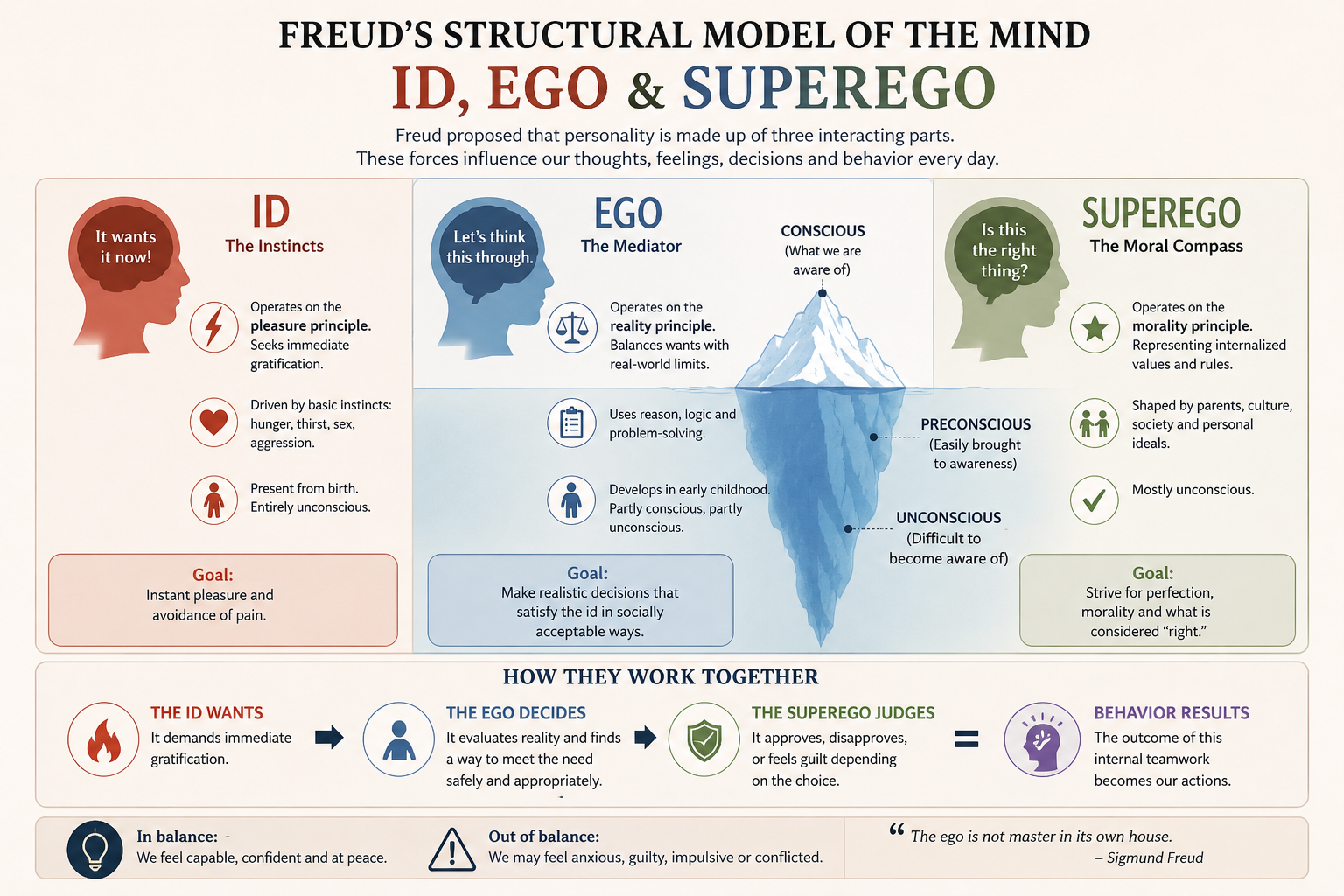
For Freud, these ideas were not only a theory of the mind. They also formed the basis of a method of treatment. His early use of hypnosis gradually gave way to free association, allowing patients to speak about their thoughts, memories, dreams and experiences without attempting to deliberately organize or censor them.
The analyst listened for patterns, contradictions, resistances and recurring themes that might reveal psychological processes outside the patient's immediate awareness. Interpretation therefore became an important part of the analytic process, with dreams, symptoms, associations and behavior providing material through which unconscious conflicts could be explored.
The therapeutic relationship itself also became significant. Freud observed that patients could develop feelings toward the analyst that resembled those experienced in earlier relationships. This phenomenon, which he termed transference, allowed aspects of the patient's interpersonal and emotional life to become observable within the treatment itself.
Psychoanalysis consequently became a form of psychotherapy centered on sustained exploration rather than the immediate removal of individual symptoms. The aim was to develop greater awareness of unconscious processes and the conflicts underlying psychological distress. Freud's later formulation, "Where ID was, there ego shall be," captures this broader objective: increasing the capacity of conscious psychological functioning to recognize and manage processes that had previously remained outside awareness.
Jungian Analysis – Carl Gustav Jung
Carl Gustav Jung initially worked closely with Sigmund Freud and was regarded by Freud as an important figure in the emerging psychoanalytic movement. Both were interested in unconscious psychological processes, dreams, symbolism and the interpretation of psychological symptoms. Their relationship, however, gradually became strained as Jung developed ideas that differed from Freud's understanding of the unconscious and the central role, he assigned to sexuality and psychosexual development.
Jung eventually developed his own approach, which he called analytical psychology. While retaining the idea that unconscious processes influence conscious life, he proposed that the unconscious contained more than repressed personal experiences. Jung distinguished between the personal unconscious, consisting of material arising from an individual's own experiences, and the collective unconscious, which he proposed contained inherited patterns shared across humanity.
These ideas became the foundation for several concepts associated with Jungian psychology, including archetypes, the persona, the shadow, the anima and animus, and individuation. Rather than focusing primarily on the resolution of unconscious conflict, Jung placed greater emphasis on the integration of different aspects of the personality and the development of the individual toward a more complete sense of self (Jung, 2012; 2014).
From Psychoanalysis to Analytical Psychology
Jung's departure from Freud illustrates an important development within the history of psychoanalysis. Psychoanalytic thought did not remain fixed around Freud's original theories. Different clinicians and theorists retained some of his ideas while challenging or replacing others, eventually giving rise to distinct schools of psychological thought.
Jungian analysis therefore shares a historical foundation with psychoanalysis while representing a significant departure from classical Freudian theory.
Core Jungian concepts
Archetypes
- Jung proposed that the collective unconscious contains inherited patterns or structures that influence how humans perceive and organize experience.
- Archetypes are not fixed images stored in the mind. Rather, they are underlying patterns that can appear through different images, stories, symbols and behaviors.
- Examples include the Hero, Mother, Wise Old Man, Child, Trickster and Self (later expanded by others such as Carol Pearson to include: the Magician, Sage, Ruler, Explorer, Creator and more).
- The same archetypal pattern can therefore appear in very different cultural forms.
Persona
- The persona is the social face a person presents to others.
- It develops through the roles and expectations associated with family, occupation, culture and society.
- A person may have a professional persona, for example, that differs considerably from how they behave privately.
- Jung did not consider the persona inherently negative. It allows a person to function socially, but problems can occur when someone becomes excessively identified with it.
Shadow
- The shadow represents aspects of the personality that the individual does not consciously accept or identify with.
- These may include socially unacceptable impulses, weaknesses or emotions, but the shadow can also contain positive qualities that a person has failed to recognize in themselves.
- A useful example would be someone who believes they must always be calm and controlled. They may suppress aggression so strongly that they become uncomfortable around assertive people.
- Boxing and dancing could make an excellent visual contrast: the same person may consciously identify with one side of themselves while discovering unfamiliar qualities through another activity. The important point is not that boxing is inherently "shadow" and dancing is inherently "persona," but that different contexts can bring different aspects of personality into awareness.
- Jung's idea of shadow integration involves becoming more conscious of these disowned aspects rather than simply projecting them onto others.
Anima and Animus
- Jung originally proposed the anima as an unconscious feminine aspect of a man's psyche and the animus as an unconscious masculine aspect of a woman's psyche.
- He associated these figures with psychological development, relationships and the individual's encounter with qualities traditionally associated with the opposite sex.
- In Jung's later writings, these concepts became more complex, but the original formulation remains strongly tied to the gender assumptions of his era.
- Jungian approaches often reinterpret anima and animus less literally, particularly in light of contemporary understandings of gender and identity.
Individuation
- It describes the process through which a person becomes increasingly aware of, and integrates, different aspects of their personality.
- The goal isn't to become a completely different person, but to develop a more differentiated and integrated sense of self.

Adlerian Therapy
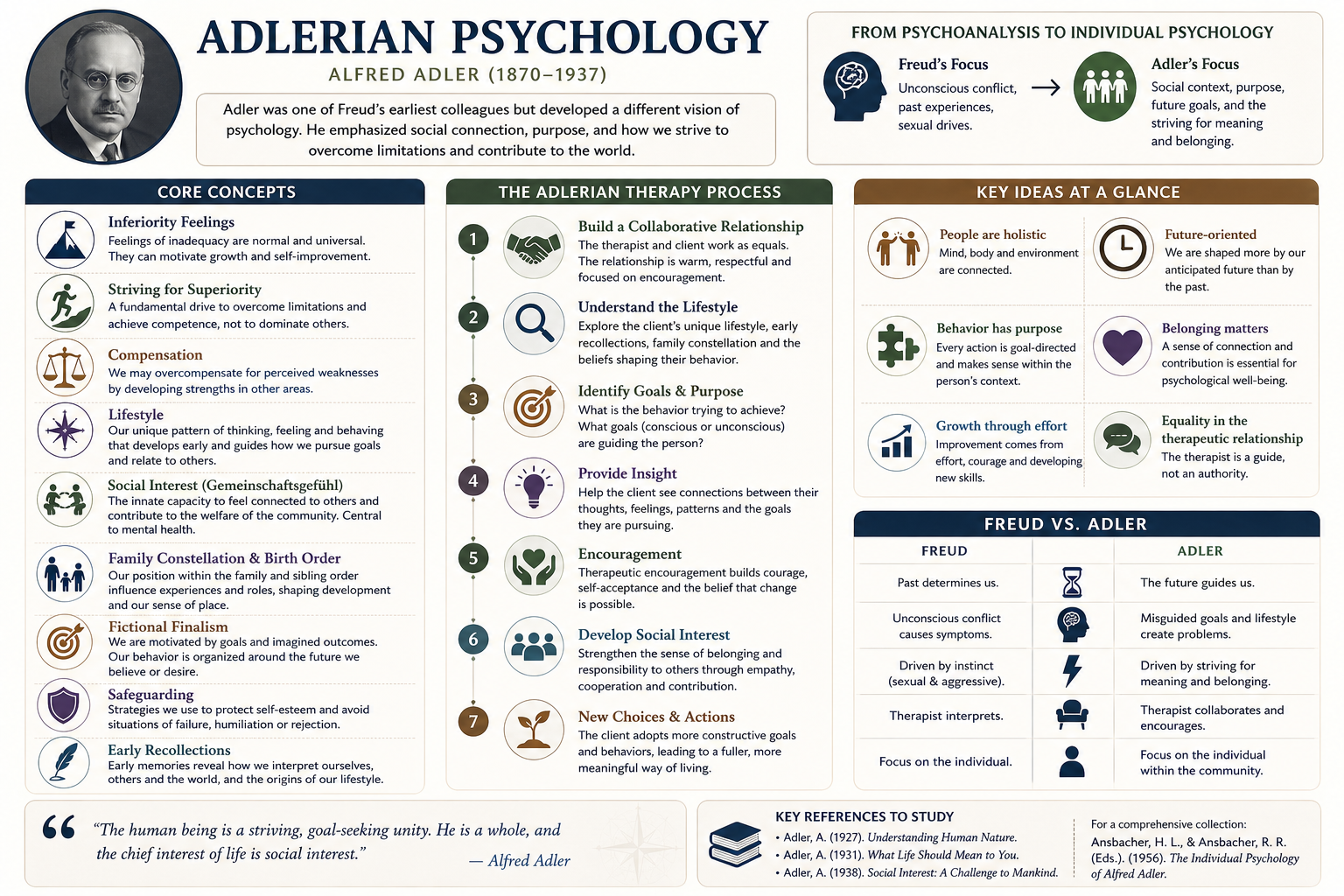
Alfred Adler was initially associated with Freud's psychoanalytic movement and became a member of the Vienna Psychoanalytic Society. Over time, however, Adler developed ideas that increasingly diverged from Freud's emphasis on sexuality and unconscious conflict. He placed greater importance on the individual's social environment, relationships, sense of belonging, and efforts to overcome perceived limitations. Adler eventually established his own school, Individual Psychology, which viewed the person as an integrated whole rather than as a collection of competing psychological forces (Oberst & Stewart, 2003; Mosak & Maniacci, 2013, pp. 1–8).
From Psychoanalysis to Individual Psychology
Adler argued that psychological functioning could not be understood independently of the individual's relationships and social environment. He proposed that people develop characteristic ways of approaching life in response to their experiences, particularly experiences of limitation, inferiority and belonging. Rather than focusing primarily on past unconscious conflicts, Adlerian psychology also asks how a person's goals and expectations about the future influence their present behavior.
Adlerian Concepts
- Inferiority Feelings: Feelings of inadequacy are a normal part of human development and can motivate efforts toward competence and mastery.
- Striving for Superiority: Adler described a general striving toward improvement, competence and significance, rather than simply a desire to dominate others.
- Compensation: Individuals may respond to perceived weaknesses by developing abilities in other areas.
- Lifestyle: A person's characteristic pattern of interpreting experiences, pursuing goals and relating to others.
- Social Interest (Gemeinschaftsgefühl): The capacity to feel connected to others and contribute to the wider community. This is one of Adler's most important concepts.
- Birth Order: Adler proposed that a child's position among siblings could influence aspects of development and family dynamics, although many strong modern claims about birth order go beyond the evidence supporting Adler's original ideas.
- Fictional Finalism: Behavior can be organized around imagined or anticipated goals that give direction and meaning to present actions.
- Safeguarding: Psychological strategies may protect a person's self-esteem or help them avoid situations in which they fear failure or humiliation.
- Early Recollections: Adlerian therapists may examine early memories to understand how a person interprets themselves, others and the world.
- Family Constellation: The individual's position and relationships within the family are considered when exploring their developing lifestyle.
References
- Ansbacher, H. L., & Ansbacher, R. R. (Eds.). (1956). The individual psychology of Alfred Adler. Basic Books.
- Freud, S. (1987). The origin and development of psycho-analysis: First and second lectures. The American Journal of Psychology, 100(3/4), 472–488. https://doi.org/10.2307/1422690
- Freud, S., & Chase, H. W. (1925). The origin and development of psychoanalysis. In Sigmund Freud's lectures at Clark University, 1910. Modern Library. https://doi.org/10.1037/11350-001
- Jung, C. G. (2012). Man and his symbols. Bantam.
- Jung, C. G. (2014). The archetypes and the collective unconscious. Routledge.
- Lear, J. (2005). Freud. Psychology Press.
- Mosak, H., & Maniacci, M. (2013). Primer of Adlerian psychology: The analytic-behavioural-cognitive psychology of Alfred Adler. Routledge.
- Oberst, U. E., & Stewart, A. E. (2003). Adlerian psychotherapy: An advanced approach to individual psychology. Brunner-Routledge.
- Pearson, C. S. (n.d.). The Pearson 12 archetype system: Human development and evolution. https://carolspearson.com/about/the-pearson-12-archetype-system-human-development-and-evolution