Humanistic Psychology: Understanding the Whole Person
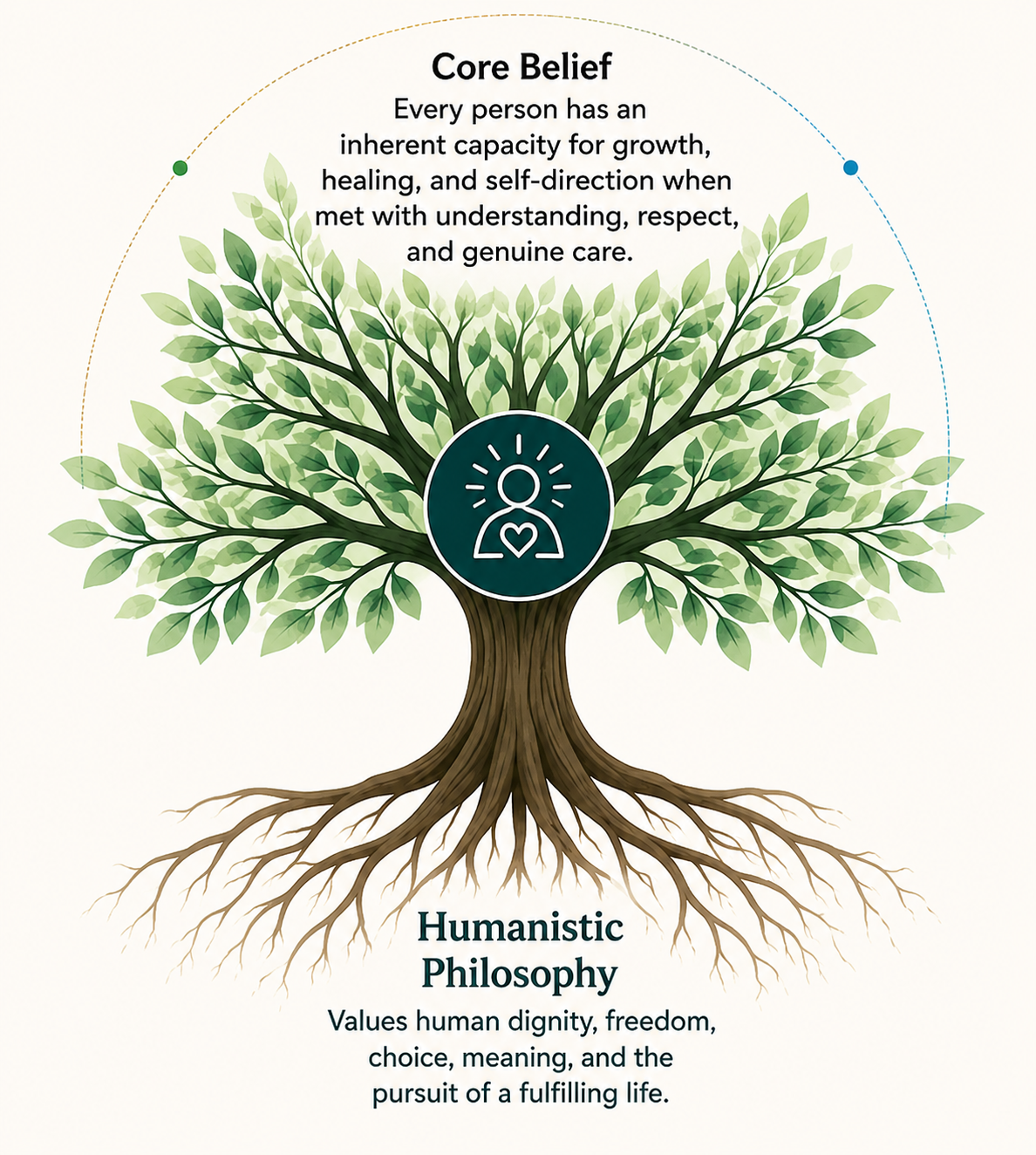
The previous articles introduced the historical development of evidence-based psychotherapies and the major schools that shaped modern clinical practice. Humanistic Psychology offered a different perspective. Rather than asking "How do we correct psychological dysfunction?", humanistic psychologists asked a broader question: "What enables people to grow?"
Humanistic Psychology emerged during the 1950s as a response to approaches that primarily explained behavior through unconscious processes or environmental conditioning. Instead, it emphasized conscious experience, personal meaning, free will, creativity, and the capacity for psychological growth (Resnick et al., 2001; Bland & DeRobertis, 2017). From this perspective, people are not passive products of their past or their environment. They possess the ability to make choices, develop new ways of understanding themselves, and pursue lives that reflect their own values and aspirations.
Although the movement is most closely associated with Carl Rogers and Abraham Maslow, many other psychologists contributed to its development, including Rollo May, Charlotte Bühler, James Bugental, Clark Moustakas, and Gordon Allport. Together, their work helped establish Humanistic Psychology as what later became known as the "Third Force" in psychology (Schneider et al., 2015).
Humanistic Psychology is not a single therapeutic approach but a broader philosophical tradition that has influenced numerous forms of psychotherapy. These include Person-Centered Therapy, Gestalt Therapy, Existential Therapy, Emotion-Focused Therapy, Focusing-Oriented Therapy, and several contemporary integrative approaches. Although each developed its own theoretical framework and clinical methods, they share a common emphasis on personal growth, authenticity, subjective experience, and the therapeutic relationship.
Within this perspective, the therapist is not viewed primarily as an expert who interprets a client's experiences, but as a collaborative partner who helps create the conditions for psychological growth. Empathy, authenticity, and respect for the client's subjective experience are therefore considered central to meaningful therapeutic change (Bland & DeRobertis, 2017).
Carl Rogers and the Origins of Person-Centered Therapy
Among the pioneers of Humanistic Psychology, Carl Rogers (1902–1987) transformed the way psychotherapy was understood. During a period when therapists were generally expected to diagnose problems, interpret unconscious conflicts, and direct treatment, Rogers proposed a different role for the clinician. He argued that clients possess an inherent capacity to understand themselves and move towards psychological growth when provided with the appropriate therapeutic conditions (Rogers, 1951).
At the heart of Rogers' theory is the concept of the actualizing tendency—an innate motivational process that drives individuals to maintain, develop, and realize their potential throughout life (Rogers, 1951). Rather than viewing psychological change as something imposed by the therapist, Rogers believed that growth occurs naturally when people experience relationships characterized by empathy, genuineness, and acceptance.
One of the most frequently cited turning points in Rogers' career comes from his early clinical work with a mother commonly referred to as Mrs. Oak (or Mrs. Q in some secondary sources). Rogers initially worked with her son, who had been referred because of behavioral difficulties. Their interactions were often marked by disagreement, leaving Rogers frustrated by what he perceived as the mother's resistance to treatment.
Everything changed when she unexpectedly asked whether he also worked with adults. During the sessions that followed, Rogers set aside interpretation and advice, choosing instead to listen carefully as she described her own fears, frustrations, and emotional struggles. He later reflected that the woman sitting before him seemed entirely different from the parent he believed he had known.
This experience became a turning point in Rogers' understanding of psychotherapy. He realized that many clients were not searching for solutions as much as they were searching for understanding. When individuals are genuinely heard, accepted, and free to explore their experiences without judgement, they often become better able to understand themselves and discover their own direction for change (Rogers, 1961).
These experiences formed the foundation of Client-Centered Therapy, later renamed Person-Centered Therapy. Instead of placing the therapist in the role of expert, Rogers proposed a collaborative therapeutic relationship in which the client remains the primary agent of change. The therapist's responsibility is not to direct the person's life, but to cultivate the psychological conditions that allow the individual's natural capacity for growth to emerge.
Rogers later formalized these ideas through concepts such as empathy, congruence, and unconditional positive regard. Together, these principles describe the interpersonal climate that supports psychological growth and remain among the most influential contributions to modern psychotherapy. They also provide the foundation for many contemporary humanistic and integrative therapeutic approaches.
Abraham Maslow and Human Potential
While Carl Rogers transformed the therapeutic relationship, Abraham Maslow (1908–1970) sought to understand what allows people to live fulfilling and meaningful lives. At a time when psychology focused largely on mental illness and psychological dysfunction, Maslow argued that the discipline should also study individuals who were healthy, creative, resilient, and functioning at their fullest potential (Maslow, 1943; Maslow, 1968).
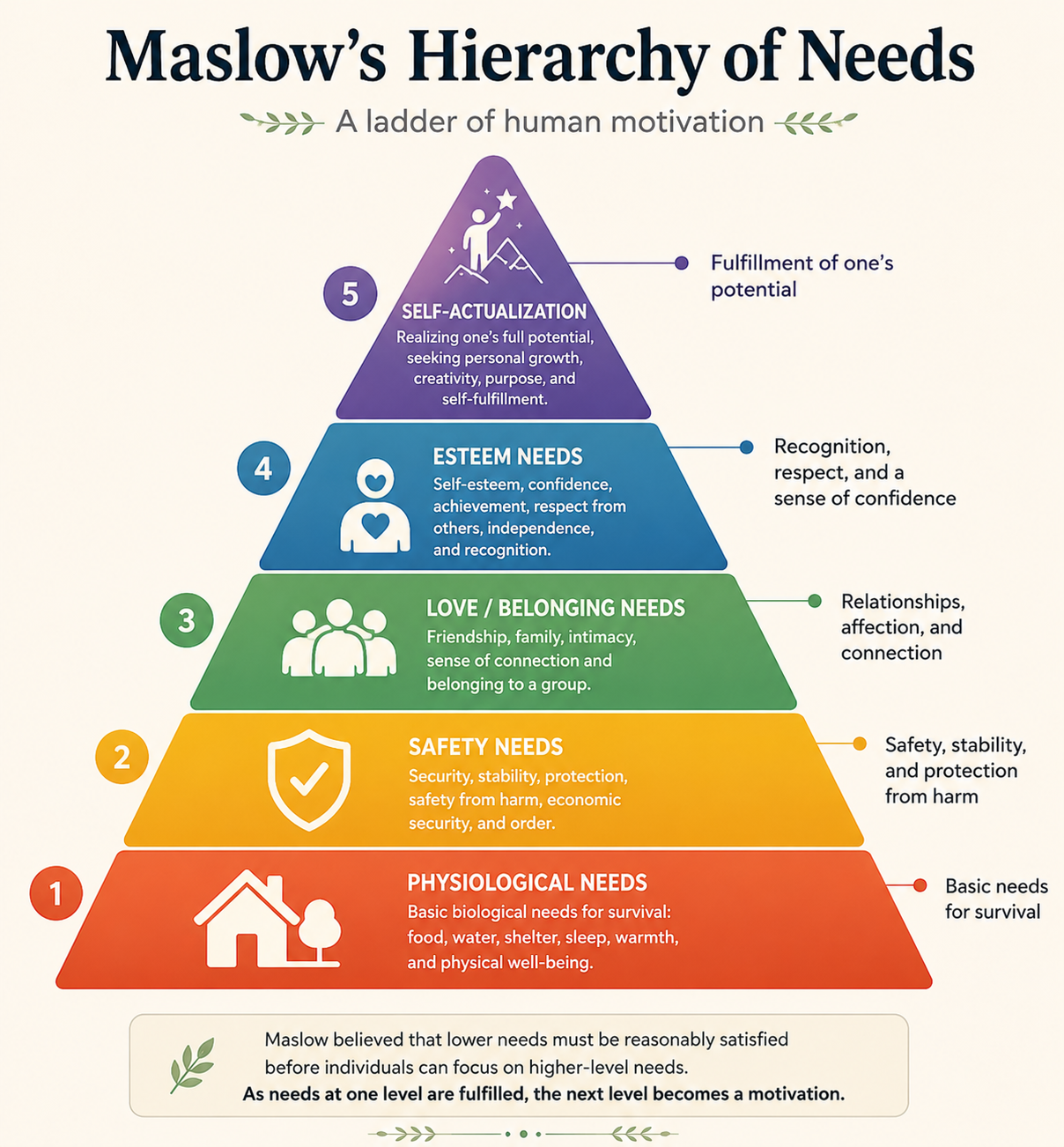
Maslow proposed that human motivation is shaped by a series of needs that influence behavior throughout life. Basic physiological and safety needs generally require reasonable fulfilment before individuals devote greater attention to psychological needs such as belongingness, self-esteem, and ultimately self-actualization—the ongoing process of developing one's abilities, values, creativity, and personal potential (Maslow, 1943).
Today, Maslow's theory is most often illustrated as a pyramid. However, his original work described human motivation as considerably more dynamic than this familiar representation suggests. Self-actualization was not viewed as a final destination, but as a continuous process of growth that could occur throughout life. In his later writings, Maslow expanded these ideas further by introducing self-transcendence, suggesting that many psychologically healthy individuals eventually seek purposes beyond personal achievement through service, creativity, spirituality, or contributing to causes greater than themselves (Maslow, 1968).
Maslow's work continues to influence psychology, education, leadership, organizational behavior, coaching, and Positive Psychology. Together with Rogers, he helped shift psychological science beyond the study of mental illness alone, encouraging researchers and clinicians to examine human strengths, resilience, meaning, and the conditions that allow people to thrive (Resnick et al., 2001).
The Humanistic Family of Therapies
Humanistic Psychology is best understood as a broad philosophical tradition rather than a single therapeutic approach. Over time, it inspired the development of several psychotherapeutic models, each with its own theoretical framework and clinical methods. Despite these differences, they share a common emphasis on subjective experience, authenticity, personal meaning, and the belief that people possess an inherent capacity for psychological growth.

| Therapeutic Approach | Principal Founder(s) | Primary Focus |
|---|---|---|
| Person-Centered Therapy | Carl Rogers | Personal growth through the therapeutic relationship |
| Gestalt Therapy | Fritz & Laura Perls | Present-moment awareness and experiential integration |
| Existential Therapy | Rollo May, Irvin Yalom | Freedom, responsibility, anxiety, and meaning |
| Logotherapy | Viktor Frankl | Meaning-making and purpose despite suffering |
| Emotion-Focused Therapy | Leslie Greenberg | Emotional awareness and transformation |
| Focusing-Oriented Therapy | Eugene Gendlin | Developing awareness of the "felt sense" |
| Motivational Interviewing | William Miller & Stephen Rollnick | Enhancing intrinsic motivation for change |
| Transactional Analysis | Eric Berne | Interpersonal communication and ego states* |
*Although Transactional Analysis is commonly discussed alongside humanistic approaches, it is more accurately considered an integrative psychotherapy influenced by humanistic, psychodynamic, and cognitive traditions rather than a purely humanistic therapy.
Together, these approaches demonstrate the lasting influence of Humanistic Psychology across modern psychotherapy. While they differ considerably in theory and technique, each places the individual's lived experience at the center of psychological understanding.
Among the many therapies influenced by Humanistic Psychology, Person-Centered Therapy remains its most influential clinical application. Rather than focusing on diagnosis or therapeutic techniques alone, Rogers argued that the quality of the therapeutic relationship itself constitutes the primary mechanism of psychological change.
References
- Bland, A. M., & DeRobertis, E. M. (2017). Humanistic perspective. In Encyclopedia of Personality and Individual Differences. Springer. https://doi.org/10.1007/978-3-319-28099-8_1484-1
- Cain, D. J. (2010). Person-Centered Psychotherapies. American Psychological Association. https://doi.org/10.1037/17330-000
- Joseph, S., & Murphy, D. (2013). Person-centered approach, positive psychology, and relational helping: Building bridges. Journal of Humanistic Psychology, 53(1), 26–51. https://doi.org/10.1177/0022167812436426
- Maslow, A. H. (1943). A theory of human motivation. Psychological Review, 50(4), 370–396.
- Maslow, A. H. (1968). Toward a Psychology of Being (2nd ed.). Van Nostrand. https://doi.org/10.1037/10793-000
- Resnick, S., Warmoth, A., & Serlin, I. A. (2001). The humanistic psychology and positive psychology connection: Implications for psychotherapy. Journal of Humanistic Psychology, 41(1), 73–101. https://doi.org/10.1177/0022167801411006
- Rogers, C. R. (1951). Client-Centered Therapy. Houghton Mifflin.
- Rogers, C. R. (1957). The necessary and sufficient conditions of therapeutic personality change. Journal of Consulting Psychology, 21(2), 95–103. https://doi.org/10.1037/h0045357
- Rogers, C. R. (1961). On Becoming a Person. Houghton Mifflin.
- Schneider, K. J., Pierson, J. F., & Bugental, J. F. T. (Eds.). (2015). The Handbook of Humanistic Psychology (2nd ed.). Sage Publications.